Why Freshers Should Learn Delegation Early
Because Doing Everything Yourself Is Not Strength—It’s a Silent Limitation

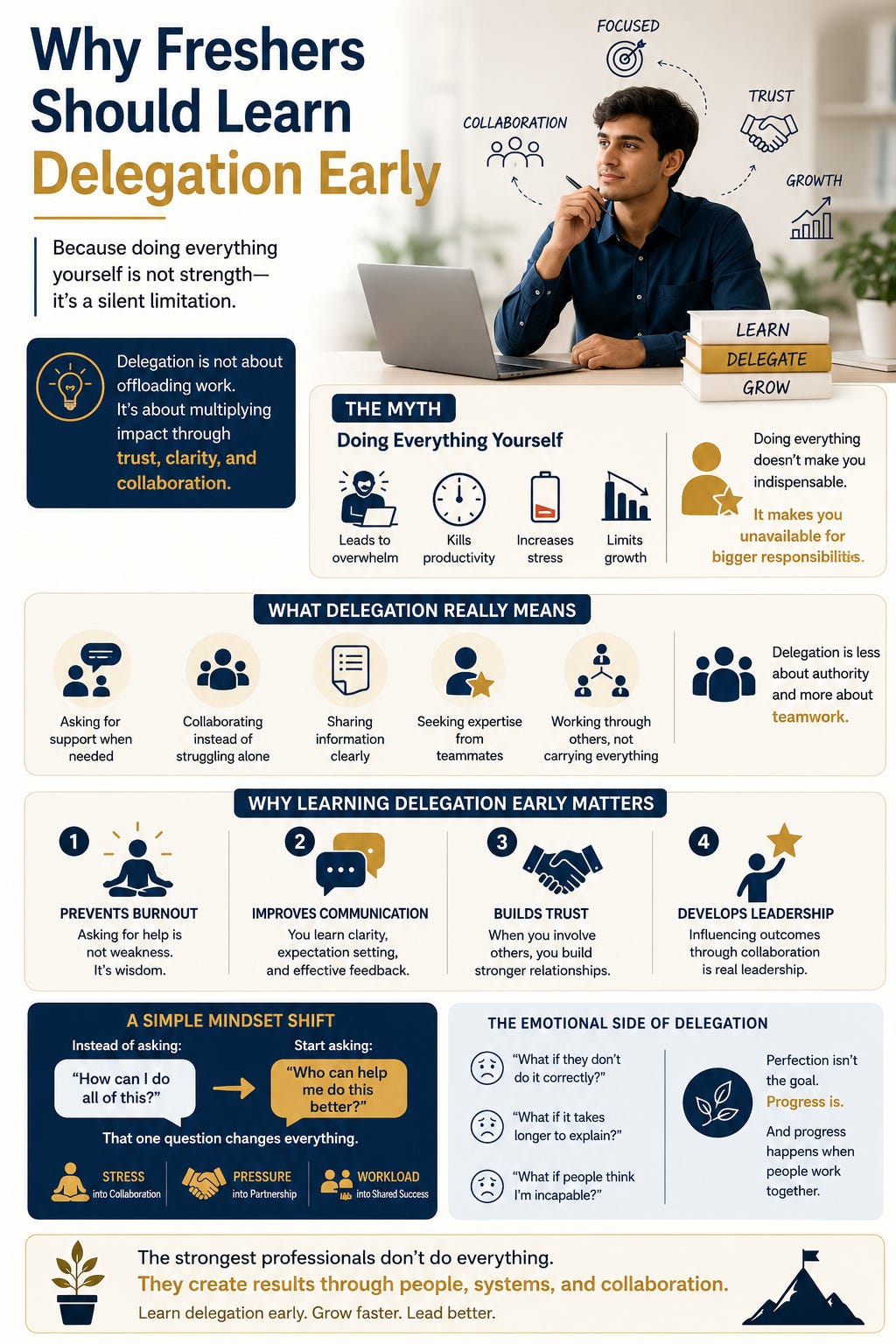
When we start our careers, most of us believe that success comes from proving ourselves.
We volunteer for every task.
We say yes to every request.
We stay late to finish work.
And secretly, we feel proud when people say,
“You handle everything.”
At first, this feels like dedication.
But over time, it becomes a trap.
Many freshers assume delegation is something managers do.
In reality, delegation is a skill every professional should start learning from day one.
Not because you’re avoiding work.
But because you’re learning how work gets done through collaboration.
The Myth of Doing Everything Yourself
Early in your career, it’s natural to want to showcase your abilities.
You want your manager to see that you’re reliable.
You want your colleagues to trust you.
You want opportunities to come your way.
But somewhere along the journey, many professionals begin equating self-worth with being busy.
The result?
They become overwhelmed.
Deadlines pile up.
Stress increases.
Learning slows down.
And growth becomes limited.
Because when you’re constantly occupied with doing, you have no time left for thinking, improving, or leading.
The truth is:
Doing everything yourself doesn’t make you indispensable.
It makes you unavailable for bigger responsibilities.
What Delegation Really Means
Delegation is often misunderstood.
People think delegation means pushing work onto someone else.
It doesn’t.
Delegation means recognizing that outcomes improve when people contribute according to their strengths.
It means trusting others.
It means sharing responsibility.
It means creating space for higher-value work.
Even as a fresher, delegation can look like:
Asking for support when needed
Collaborating instead of struggling alone
Sharing information clearly
Seeking expertise from teammates
Learning to work through others rather than carrying everything yourself
Delegation is less about authority and more about teamwork.
Why Learning Delegation Early Matters
1. It Prevents Burnout
Many young professionals burn out not because the work is difficult but because they try to carry everything alone.
Delegation teaches you that asking for help is not weakness.
It’s wisdom.
2. It Improves Communication Skills
Effective delegation requires clarity.
You learn how to explain expectations, share context, and communicate outcomes.
These are leadership skills that will serve you throughout your career.
3. It Builds Trust
When you involve others, you create stronger relationships.
People appreciate being trusted.
Teams perform better when responsibilities are shared.
4. It Develops Leadership Potential
Leadership isn’t about having people report to you.
Leadership is about influencing outcomes through collaboration.
The earlier you learn this, the faster you grow.
The Emotional Side of Delegation
Many people struggle with delegation because of fear.
“What if they don’t do it correctly?”
“What if it takes longer to explain?”
“What if people think I’m incapable?”
These fears are normal.
But they often come from the need to control everything.
Great professionals understand that perfection isn’t the goal.
Progress is.
And progress happens when people work together.
A Simple Mindset Shift
Instead of asking:
“How can I do all of this?”
Start asking:
“Who can help me do this better?”
That one question changes everything.
It transforms stress into collaboration.
Pressure into partnership.
Workload into shared success.
The strongest professionals aren’t the ones carrying the heaviest load.
They’re the ones who know how to create results through people, systems, and collaboration.
As a fresher, your goal shouldn’t be to prove that you can do everything.
Your goal should be to learn how to contribute effectively while helping others contribute too.
Because doing everything yourself may look like strength.
But true professional growth begins when you learn that success is rarely a solo achievement.
And the leaders of tomorrow are the people who understand that today.